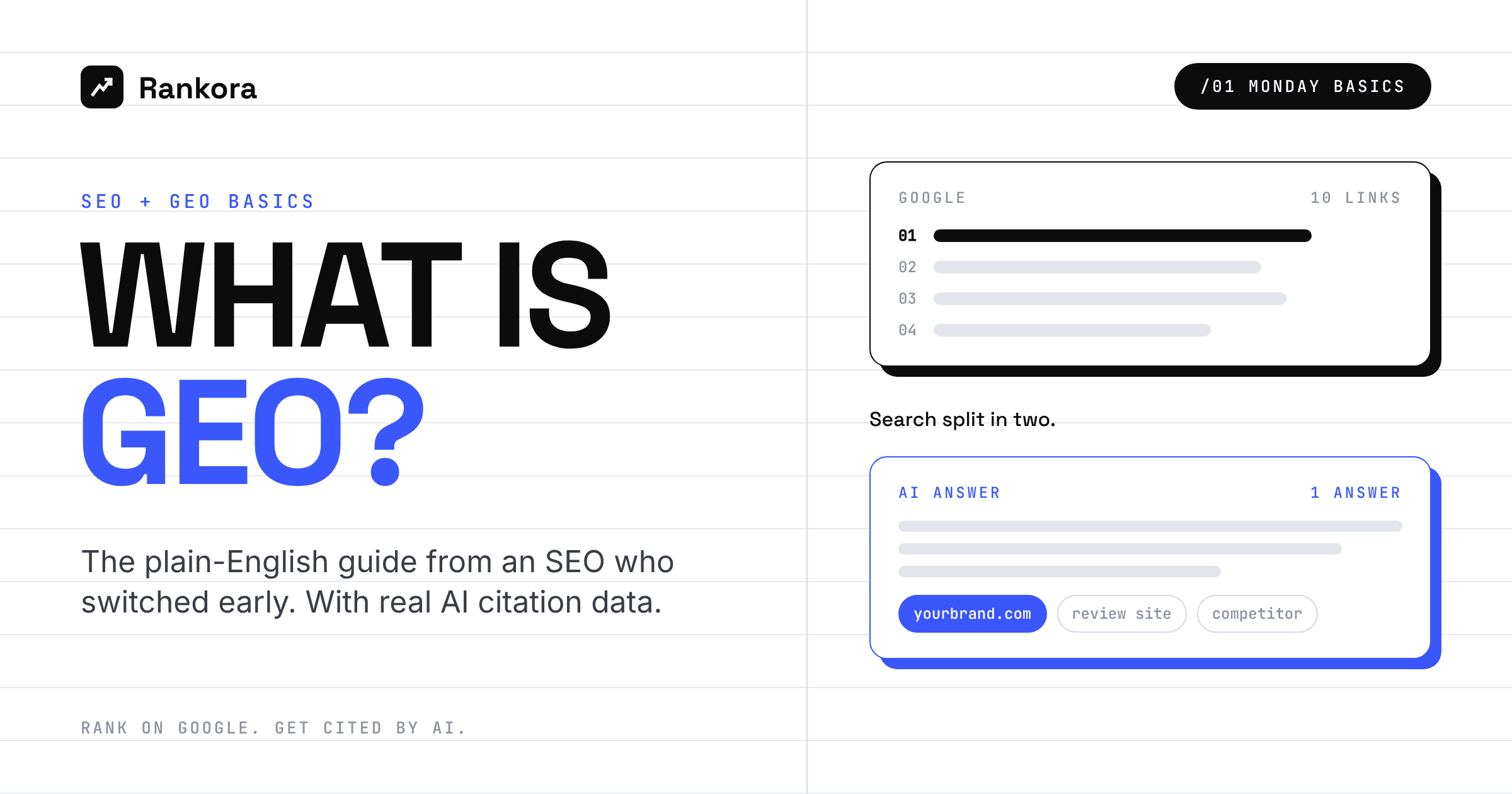
Search split in two. Most brands only noticed one half.
I started in digital marketing running paid Meta ads. Then I moved into SEO, because I got tired of paying for every single click. That was ten years ago.
A few years in, I watched AI search start taking real questions away from Google, and I pivoted early. Not away from SEO. On top of it.
Here is why. People still Google things. But a growing number now ask ChatGPT, Perplexity, Gemini or Claude and never see a list of ten blue links. The AI reads the web, picks a few brands, and hands over one answer. If your brand is not inside that answer, you do not exist for that person.
That second half of search has a name: GEO.
Further down, I will show you exactly what that looks like with one real brand and real data.
What is GEO, in one sentence?
Generative Engine Optimization (GEO) is the work of making your brand the source AI engines quote, cite or recommend when someone asks them a question.
That is it. No mystery.
Here is the one difference that matters. SEO earns you a spot on a list. GEO earns you a mention inside the answer.
On Google, the user sees ten results and picks one. In ChatGPT, the user sees one answer. The AI has already done the picking. Your job is to be what it picks.
How AI engines decide who to cite
Nobody outside these companies knows the exact formula. But across the client sites I track, these five signals keep showing up.
It can find you. Engines like Perplexity and ChatGPT search the live web before answering. If you are not crawlable and indexed, you are not in the pool.
It understands who you are. A clear About page, consistent brand name, and structured data tell the AI what entity you are and what you are known for.
Your page answers the question directly. AI pulls clean, quotable passages. A page that answers in the first two lines beats one that warms up for 300 words.
Other sites talk about you. Mentions on trusted sites, reviews, directories and forums act as votes. AI leans on what the wider web already says.
Your content is current. Dated, stale pages lose to fresh ones on any topic that changes.
Notice something? Four of those five are just good SEO.
You will see every one of these play out in the case study below.
SEO vs GEO at a glance
SEO | GEO | |
|---|---|---|
Where you show up | Google results page | Inside ChatGPT, Perplexity, Gemini, Google AI answers |
What you win | A ranking position | A mention, citation or recommendation |
What the user sees | 10 links, picks one | 1 answer, AI already picked |
Main metric | Rankings, clicks, traffic | Share of AI mentions for your key prompts |
What wins | Relevance, links, technical health | Clear entity, direct answers, trusted mentions, freshness |
How you track it | Search Console, rank trackers | Prompt testing, AI visibility tracking |
GEO does not replace SEO. It sits on top of it. A site with weak SEO rarely gets cited, because the AI never finds it in the first place.
Case study: a well-known brand that AI forgets when buyers shop
Theory is cheap. So on 20 October I ran a real brand through Rankora's AEO & GEO module myself: Wati (wati.io), the WhatsApp Business API platform that thousands of ecommerce teams use.
I picked Wati on purpose. It is an established brand with real SEO behind it. If GEO were just SEO with a new name, Wati should sail through.
Rankora asked ChatGPT, Gemini, Claude and Perplexity three questions with web search on. One is a brand question. Two are the questions a buyer asks before they know which tool they want:
Is Wati a good platform for WhatsApp automation, and how does it compare?
Which WhatsApp Business API platforms are best for a 10-person ecommerce team that wants AI agents with human handoff?
What is the best way for a small D2C brand to automate WhatsApp and Instagram DM replies so we stop losing sales overnight?
That gave us 12 answers and 145 citations.
Named is not the same as cited
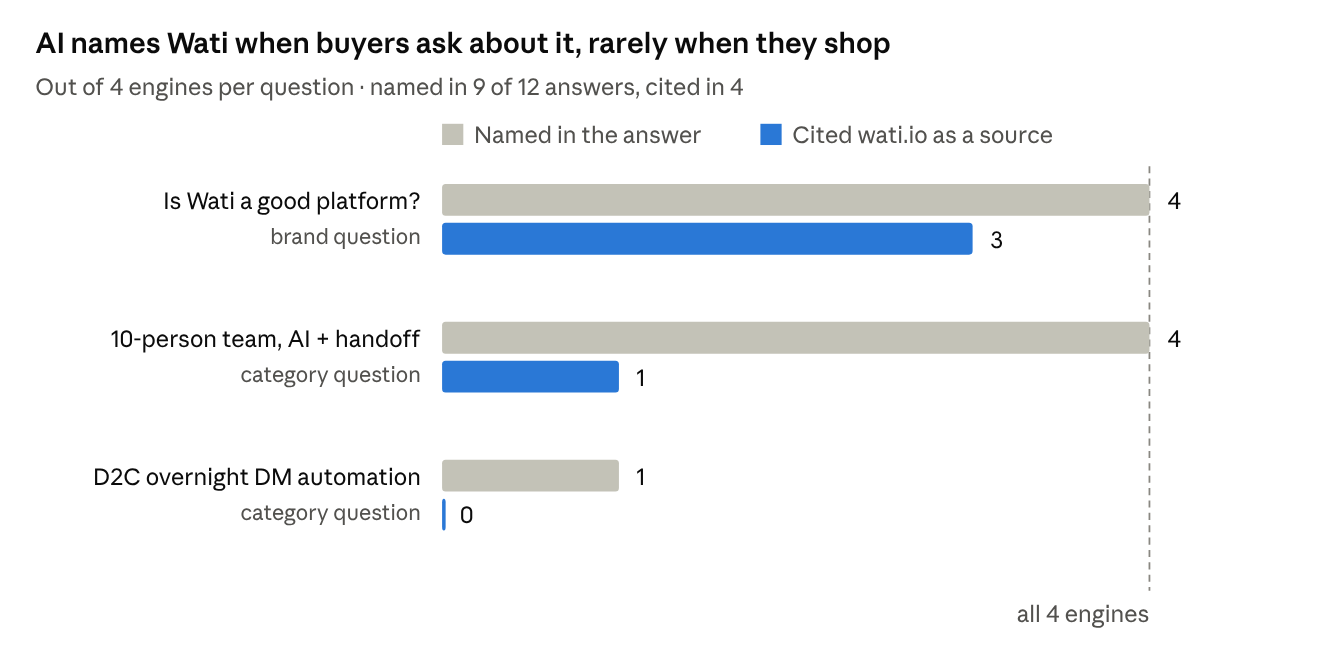
Wati was named in 9 of 12 answers. Sounds great. But it was cited as a source in only 4, and 3 of those came from the brand question, where the buyer already typed "Wati".
On the D2C question, the one closest to Wati's own pitch, three of four engines did not mention it at all. Claude built its answer from Manychat, Heyy, TailorTalk and others. Wati was never even in the pool.
Who AI trusts instead
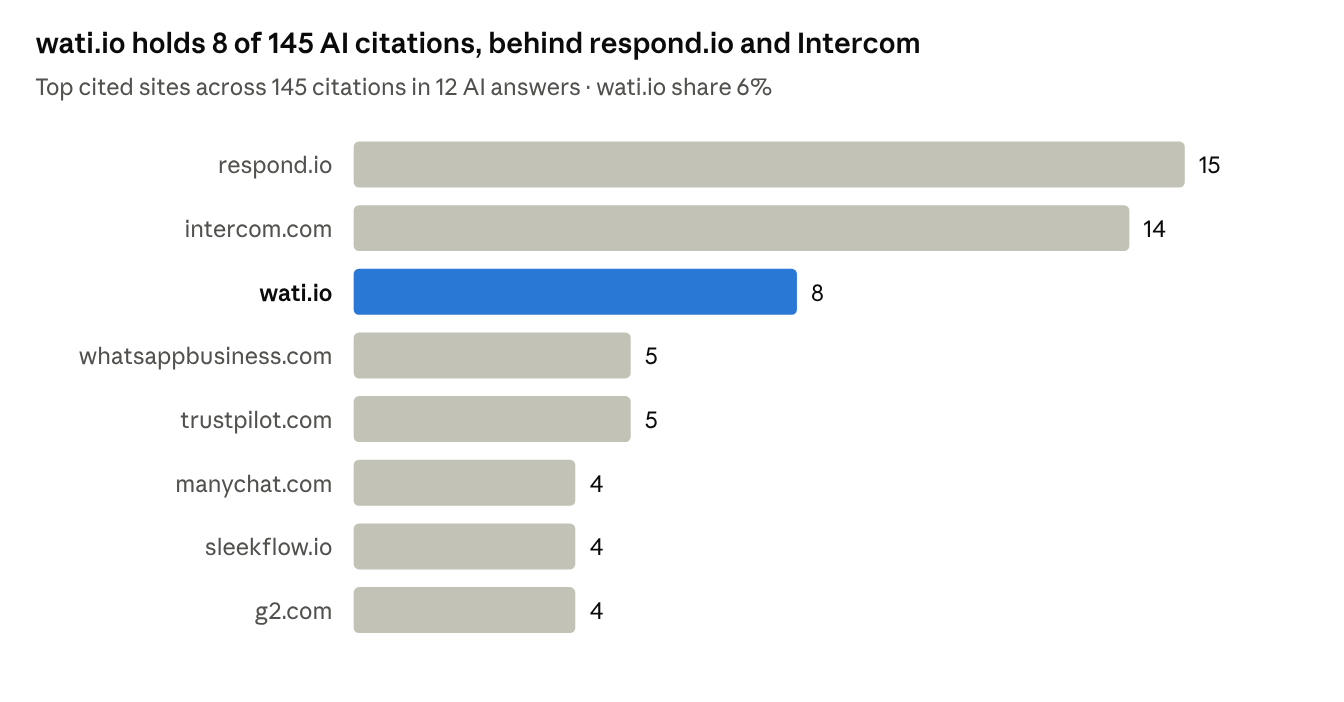
respond.io and Intercom took 29 citations between them. Trustpilot and G2 sit right next to Wati. Comparison pages and review sites are doing the talking for this category.
What the readiness check found
Rankora also scored the page itself against seven answer-engine checks. It failed four.
Check | Result |
|---|---|
FAQ or Q&A schema | Fail |
Question-shaped headings | Fail, 0 found |
Any structured data | Fail, none |
Readable prose | Fail, grade 14.8 |
Answer near the top | Pass |
Enough substance to quote | Pass, 1,793 words |
Clear heading structure | Pass |
What this teaches about GEO
1. Brand fame does not carry into category answers. AI knows Wati when you say its name. When a buyer describes a problem instead, it reaches for whoever owns that question.
2. Comparison pages win comparison questions. Every category answer here was a ranked list. Engines built it from roundups because Wati has no owned page that answers "which platform is best for a 10-person team".
3. A mention is borrowed, a citation is owned. ChatGPT listed Wati in its thinking, then cited the aggregator pages it read, not wati.io. The brand got paraphrased from someone else's article.
4. The fixes are boring and specific. Add structured data. Turn headings into the questions buyers ask. Publish real prices. Write shorter sentences. None of it needs a big budget.
The honest caveat: AI engines are not consistent. Run the same questions tomorrow and the sources can shift. This is a snapshot from one day, not a verdict on Wati. That is exactly why GEO needs tracking, not a one-time check.
5 GEO basics you can start this week
Answer first, explain second. Put the direct answer to the page's main question in the first two sentences. AI quotes what is easy to lift.
Make your brand unmistakable. One consistent name everywhere. A real About page that says who you are, what you do and who you serve. Add Organization schema.
Add an FAQ block to key pages. Use the exact questions your customers ask, and answer each in two or three lines. Mark it up with FAQ schema.
Get mentioned where AI already looks. Industry directories, review sites, Reddit threads, podcasts, guest posts. One honest mention on a trusted site beats ten on spammy ones.
Test your own prompts every month. Ask ChatGPT, Perplexity and Gemini the 10 questions your buyers would ask. Note who gets named. If it is your competitor, study their page.
None of this needs a big budget. It needs consistency.
How to check if AI is mentioning you
The free way: open a spreadsheet. List 10 to 20 questions your customers ask. Make sure most of them do not contain your brand name. Run each one in ChatGPT, Perplexity, Gemini and Claude once a month. Mark two things: were you named, and were you linked. It takes about an hour.
The faster way: this is the exact problem I built Rankora to solve. The AEO & GEO module asks all four engines your questions with web search on, then shows you who got named, who got cited, which pages they read, and what to fix. The Wati report above took one run and cost $0.36.
Why I built Rankora
When I started freelancing, I bought a SEMrush subscription. It was a great tool. It was also more than a new freelancer could comfortably pay every month.
That stuck with me. Now search has two halves, and most tools still only track one. So we built Rankora to track both, at a price a freelancer or a small agency can actually afford.
Rank on Google. Get cited by AI. That is the whole idea.
Every Monday on this blog, we break down one SEO or GEO basic in plain English. See you next week.
FAQ
What does GEO stand for? Generative Engine Optimization. It means optimizing your brand to be cited or recommended by AI engines like ChatGPT, Perplexity and Gemini.
Is GEO replacing SEO? No. GEO builds on SEO. AI engines mostly find sources through the same web that search engines crawl, so weak SEO usually means weak GEO.
How long does GEO take to show results? It varies by site. In my experience, sites with solid SEO foundations see AI mentions sooner than sites starting from zero.
Do I need a special tool for GEO? No. You can start with manual prompt testing. A tool like Rankora saves time once you track many prompts or many clients.
Tagged