How to Check If ChatGPT, Perplexity and Gemini Mention Your Brand
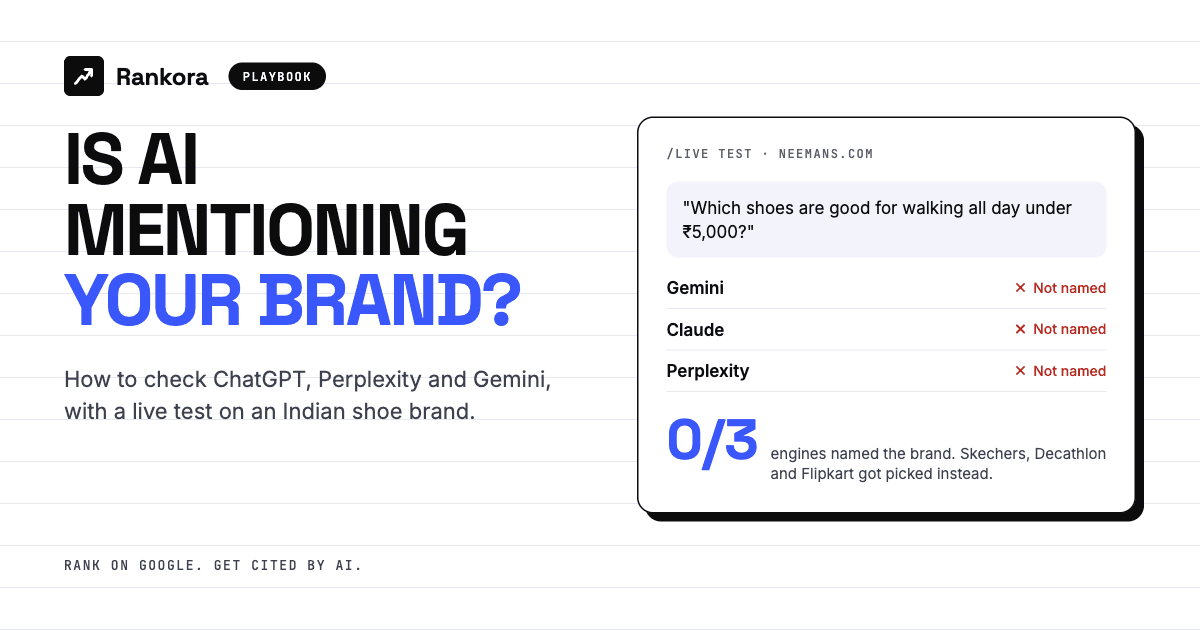
We asked Gemini, Claude and Perplexity a simple shopping question: which shoes are good for walking all day under ₹5,000?
Neeman's sells exactly that. It's one of India's better-known comfort shoe brands. Its site scores 86% on answer-engine readiness.
It got zero mentions. Zero citations. Across all three engines.
Skechers, Decathlon, Flipkart and Amazon took the answer instead. And nobody at Neeman's would know, because no Google Search Console report shows what an AI engine said.
That's the gap this post closes. By the end, you'll know how to check whether ChatGPT, Perplexity and Gemini mention your brand, first by hand and then at scale, using the real Neeman's run as our example.
Why your Google rankings don't tell you your AI visibility
Ranking on Google and being recommended by AI are two different outcomes. You can win one and lose the other.
Google gives a buyer ten blue links and lets them choose. An AI engine reads those sources for the buyer, picks two or three names, and writes the answer. If you're not in that answer, the buyer never sees you.
Three things make AI visibility hard to read from SEO data:
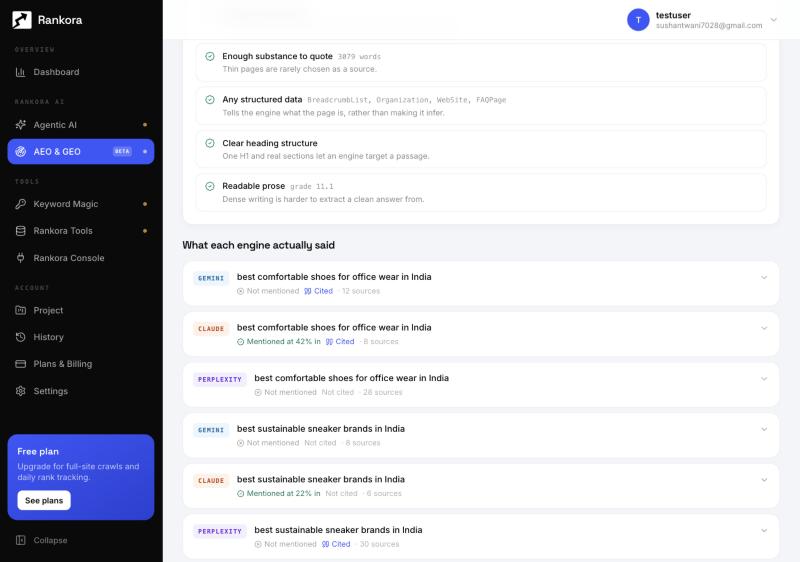
Each engine picks sources differently. In our run, Claude named Neeman's in 2 of 3 answers. Gemini and Perplexity named it in none. Same brand, same day, same prompts.
Being cited is not the same as being named. Gemini used neemans.com as a source for office shoes, then recommended Clarks and Hush Puppies in the answer itself.
Engines often trust others more than your own site. Perplexity listed Neeman's for sustainable sneakers, but credited Vogue India, Esquire India and green-fashion listicles as the source, not neemans.com.
None of this shows up in your rank tracker. You have to ask the engines directly.
The manual method: check it yourself in 30 minutes
Start by hand. It costs nothing and shows you what buyers actually see.
Step 1: Write 5 to 10 buyer prompts
Write questions the way a buyer types them, not the way you'd write a keyword. Cover four types:
Prompt type | Example (shoe brand) |
|---|---|
Category | best comfortable shoes for office wear in India |
Value | best sustainable sneaker brands in India |
Budget | which shoes are good for walking all day under 5000 rupees |
Comparison | Neeman's vs Skechers for daily walking |
The budget prompt matters most for D2C brands. In our run, it was the one Neeman's lost completely.
Step 2: Run each prompt in every engine
Open ChatGPT, Perplexity and Gemini. Use a fresh chat or a logged-out window so your history doesn't steer the answer. Turn web search on where the engine offers it.
Step 3: Record what you see
For every answer, log five things:
Prompt | Engine | Brand named? | Your site cited? | Who got cited instead |
|---|---|---|---|---|
walking all day under ₹5,000 | Perplexity | No | No | |
office wear in India | Gemini | No | Yes | Clarks, Hush Puppies named |
"Named" and "cited" are separate columns for a reason. Being a source with no name in the answer is a half win.
Step 4: Note the pattern, not the single answer
AI answers change between sessions. One answer tells you little. Ten answers across three engines tell you where you're strong, where you're invisible, and which competitors keep getting picked.
Where the manual method breaks
The manual method works once. It falls apart the moment you need it every week.
The maths gets ugly fast. 10 prompts × 4 engines = 40 answers. Repeat weekly and that's 160 answers a month, per brand.
You can't count sources by hand. Perplexity alone pulled 28 sources for one office-shoe prompt. Tallying who got cited across 112 sources is spreadsheet work nobody finishes.
Agencies multiply the problem. Ten clients means ten tracking sheets, and a weekly report you'll quietly stop sending.
You see the result, not the reason. A spreadsheet tells you that you weren't mentioned. It doesn't tell you what on your page to change.
That last point is where a tool earns its keep.
How to check AI brand mentions in Rankora, step by step
Rankora's AEO & GEO tool asks ChatGPT, Gemini, Claude and Perplexity your buyer questions with web search on, then reports whether you were named, whether you were cited, and who got cited instead. Here's the exact run we did for Neeman's.
Step 1: Add the website and brand name
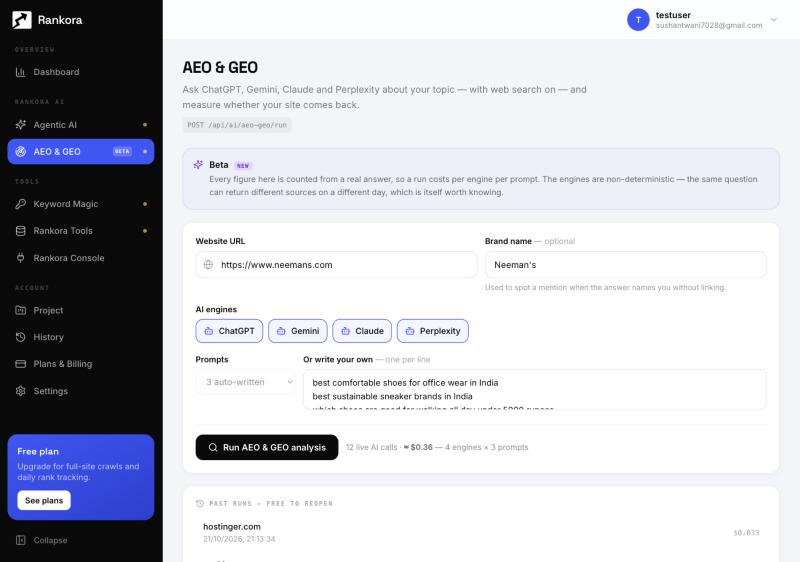
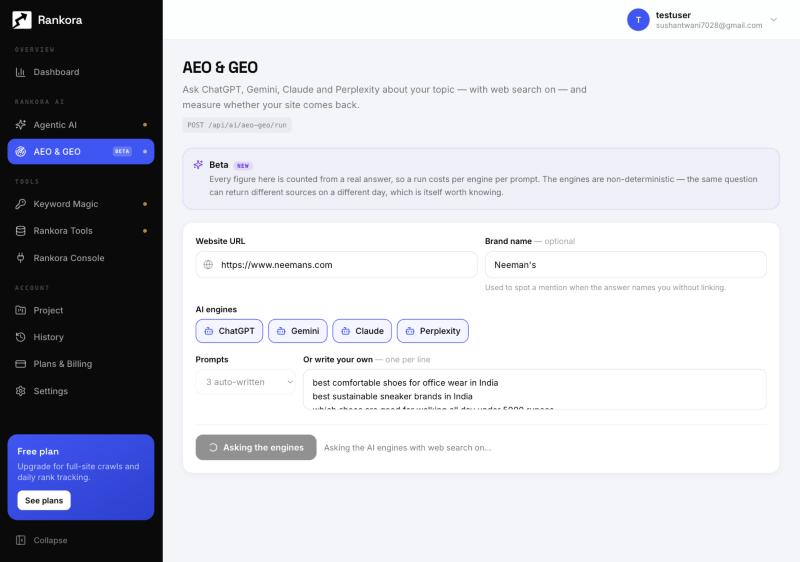
Open AEO & GEO from the sidebar. Enter the website URL (we used neemans.com) and the brand name (Neeman's).
The brand name is optional, but add it. It lets Rankora catch answers that name you without linking to you.
Step 2: Pick your engines
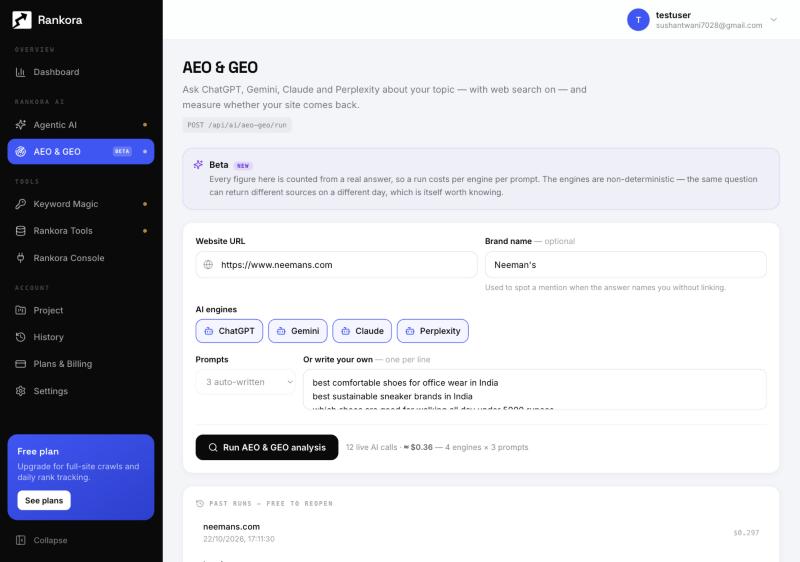
Select the engines to test: ChatGPT, Gemini, Claude and Perplexity. Rankora shows the cost before you run, so there are no surprises. Our run was 12 live AI calls for about $0.36.
Step 3: Add your prompts
You have two options. Let Rankora auto-write 1 to 5 buyer prompts, or write your own, one per line. We wrote our own three: office wear, sustainable sneakers, and walking under ₹5,000.
Step 4: Run it
Click Run AEO & GEO analysis. Rankora asks each engine live, so it takes about a minute.
When it finishes, the run is saved to Past Runs with its cost, free to reopen any time.
Step 5: Read the four score cards
The report opens with four numbers:
Metric | What it means | Neeman's |
|---|---|---|
Mention rate | Answers that named the brand | 22% (2 of 9) |
Citation rate | Answers that linked the site as a source | 33% (3 of 9) |
Share of citations | Your share of every source the engines used | 4% (5 of 112) |
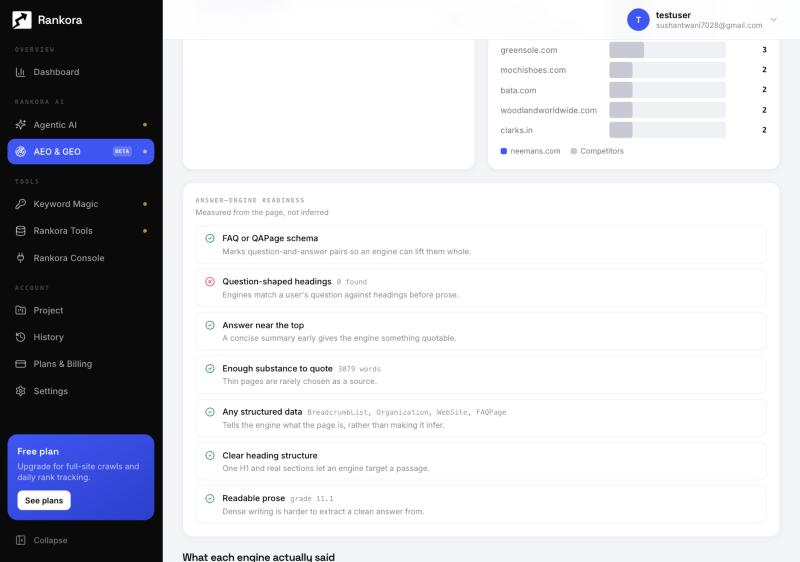
AEO readiness | Page checks passed | 86% (6 of 7) |
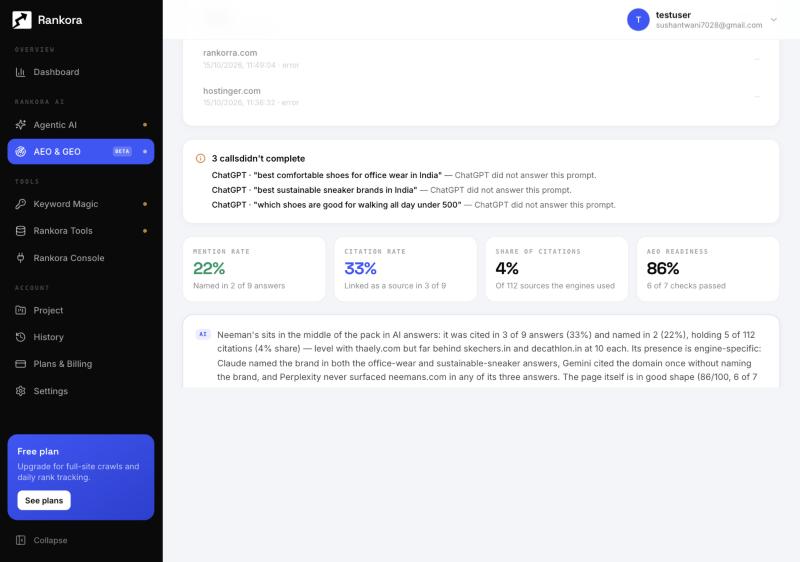
Note: ChatGPT didn't return an answer on this run, so the report covers 9 answers from Gemini, Claude and Perplexity. Rankora flags failed calls at the top of the report instead of hiding them.
Step 6: Check visibility by engine and who got cited
This is the most useful screen. On the left, mention rate per engine. On the right, every domain the engines reached for, with yours highlighted.
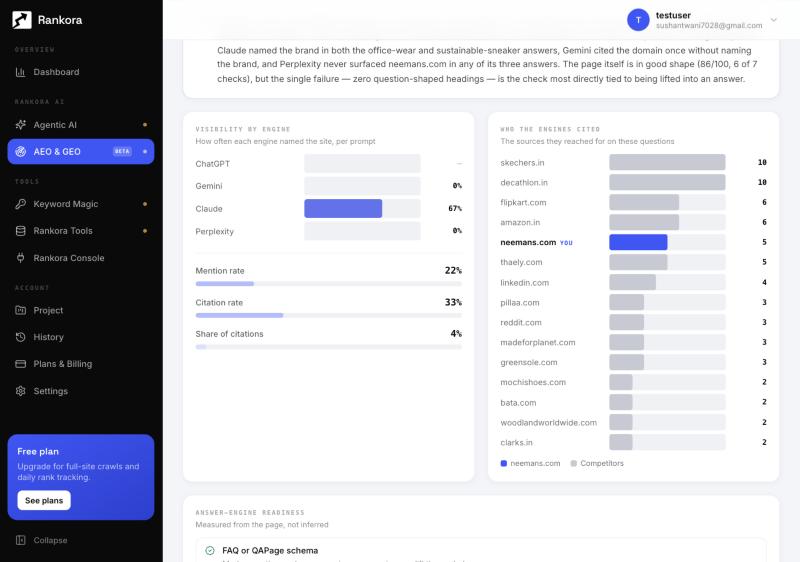
Step 7: Check the readiness checklist
Rankora measures the page itself: FAQ schema, question-shaped headings, an answer near the top, word count, structured data, heading structure and readability.
Step 8: Read what each engine actually said
Every prompt and engine gets its own row: mentioned or not, cited or not, and how many sources it used. Open any row to see the answer.
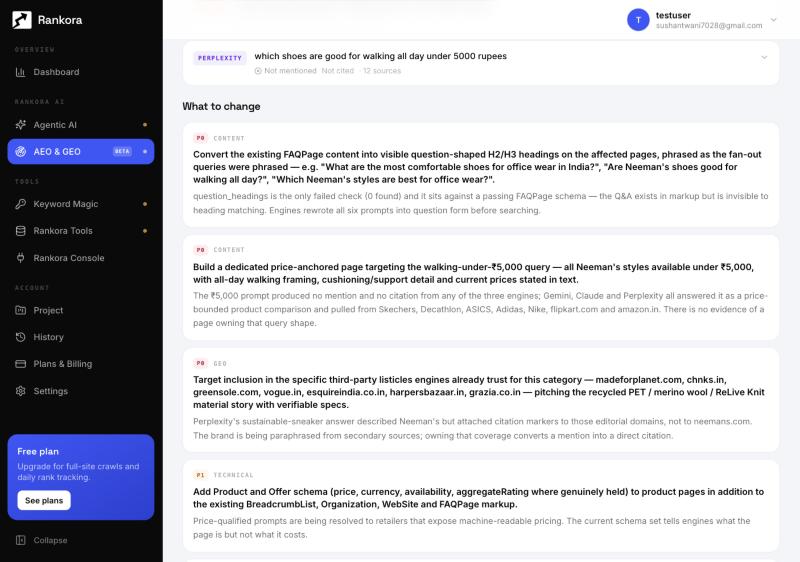
Step 9: Work through "What to change"
The report ends with fixes ranked P0 to P2, each tagged Content, GEO or Technical, with the evidence behind it. Then a plain-language list of why the engines didn't cite you, and your content gaps.
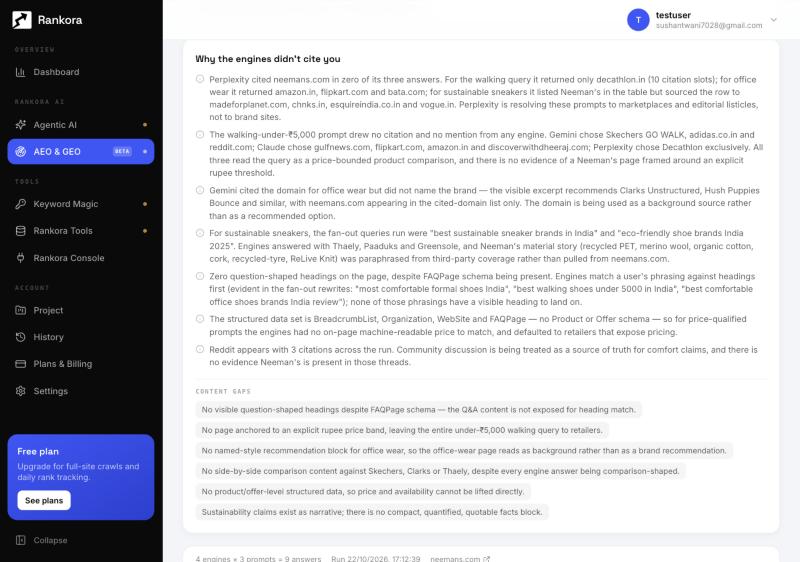
Past runs are saved and free to reopen, so you can compare next month's run against this one.
What the Neeman's run tells us
Neeman's isn't invisible. It's outsourced. Marketplaces and editorial sites are getting credit for a story Neeman's should own.
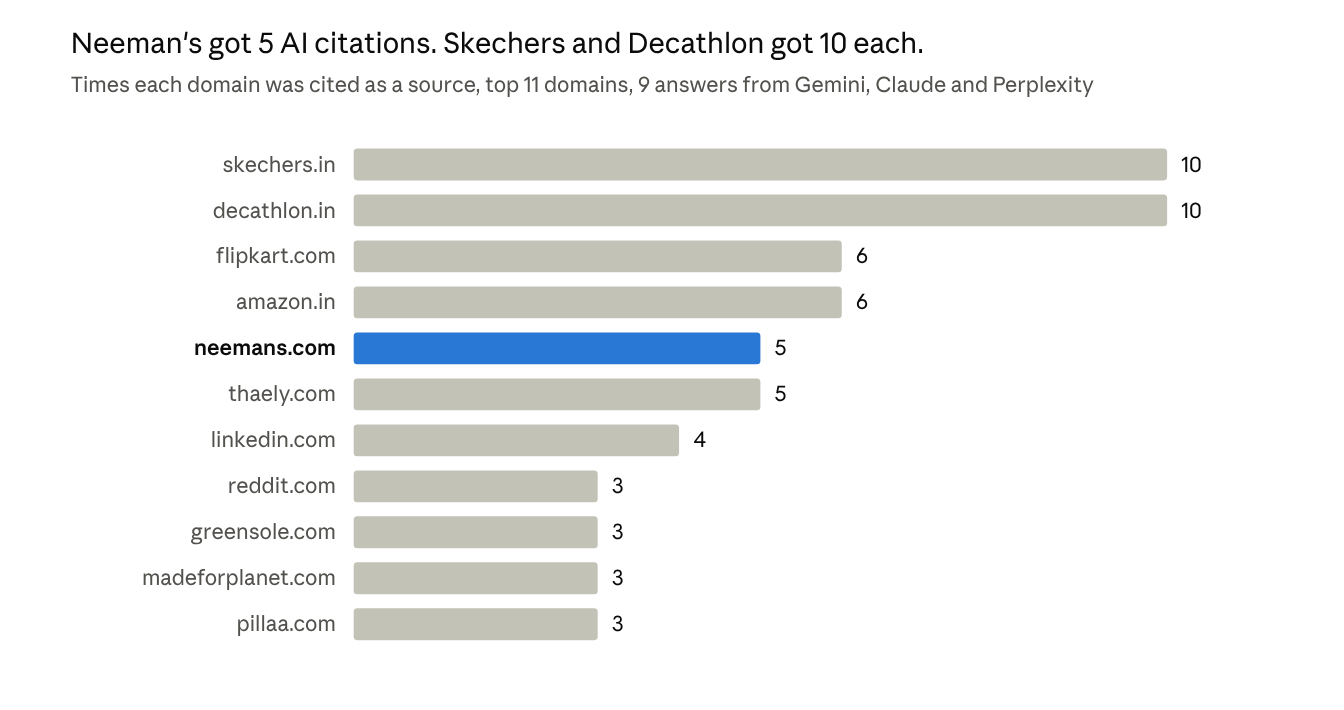
Rankora AEO & GEO run on neemans.com, 22 Oct 2026. Top 11 of 112 sources.
Flipkart and Amazon each out-cite neemans.com. That's the brand losing attention to the places that sell its own shoes. Four patterns stand out:
Visibility depends on the engine. Claude named Neeman's in 2 of 3 answers. Gemini and Perplexity named it in none. One engine's result tells you nothing about the others.
The budget query is a total loss. "Walking all day under ₹5,000" got no mention and no citation from any engine. Every engine treated it as a price comparison and went to sites that show prices clearly.
Cited but not recommended. Gemini used neemans.com as a source for office shoes, then recommended Clarks and Hush Puppies. The page was read as background, not as an answer.
One failed check costs the most. The site has FAQ schema but zero question-shaped headings. Engines rewrote every prompt into a question before searching, and there was no heading for those questions to land on.
What to do when AI doesn't mention you
These fixes come straight from the Neeman's report. Most apply to any brand that sells online.
Fix first (highest impact)
Turn your FAQs into visible question headings. Schema alone isn't enough. Write H2s and H3s the way buyers ask: "What are the most comfortable shoes for office wear in India?"
Build a page for every price question buyers ask. If people search "under ₹5,000", have a page that lists your products under ₹5,000, with prices written in the text.
Get into the lists AI already trusts. Find the editorial and listicle sites the engines cite for your category. Pitch them with specific, verifiable facts about your product.
Fix next
Add Product and Offer schema. Price, currency and availability in structured data. Engines go to retailers for price questions because retailers make price easy to read.
Fix your marketplace listings. If Amazon and Flipkart out-cite your own site, make those listings complete and accurate. Join the Reddit threads where buyers discuss your category, honestly.
Publish comparison pages. Every answer in our run was a ranked list or a table. A page like "Neeman's vs Skechers for office wear" puts you inside the frame the engines already use.
Put a clear recommendation near the top. Name your products, who they're for and why, in one or two quotable sentences. That's the difference between being a source and being the answer.
Then polish
Turn claims into numbers. "Made with recycled materials" is vague. "X% recycled PET in this style" is a fact an engine can quote.
None of these guarantees a mention. AI answers change and no one controls them. But each fix removes a specific reason the engines gave for picking someone else.
How often to check
Check monthly for a baseline. Check weekly when you're actively changing pages or running a PR push.
The same question can return different sources on a different day. So never react to one answer. Watch the trend: is your mention rate climbing, and are you taking citations back from marketplaces and listicles?
Keep your prompts fixed between runs. Change the prompts and you can't compare the results.
FAQ
Can I see how often ChatGPT recommends my brand?
Yes. Run the same buyer prompts regularly and track how many answers name you. That's your mention rate. Doing it by hand works for a few prompts. A tool like Rankora does it across ChatGPT, Gemini, Claude and Perplexity in one run.
Why does Claude mention my brand but Perplexity doesn't?
Each engine picks sources differently. In our Neeman's run, Claude named the brand in 2 of 3 answers, while Perplexity leaned on marketplaces and editorial lists. Track each engine separately.
What's the difference between being mentioned and being cited?
Mentioned means the answer names your brand. Cited means the engine used your site as a source. You can be cited without being named, which is what happened to Neeman's on Gemini.
Does ranking on Google help me get cited by AI?
It helps, but it's not enough. AI engines rewrite the buyer's question, pick a few sources and write one answer. Pages built around real questions, clear answers and specific facts get picked more often.
How long before my changes show up in AI answers?
There's no fixed timeline. Engines with live web search can pick up changes once your pages are crawled again. Re-run the same prompts monthly to see what moved.
Find out where you stand
Neeman's has a strong site, real products and an 86% readiness score. It still lost a ₹5,000 shoe question to Skechers, Decathlon and two marketplaces. If that can happen to an established brand, it's worth 10 minutes to check yours.
Run your brand through the manual method today. When you're ready to track it across all four engines, see who's getting cited instead of you, and get a ranked list of what to fix, run it in Rankora.
Run your first AI visibility check in Rankora
Rank on Google. Get cited by AI.
Every Thursday is Rankora Playbook day: one practical walkthrough of how to get more from Rankora.
Tagged