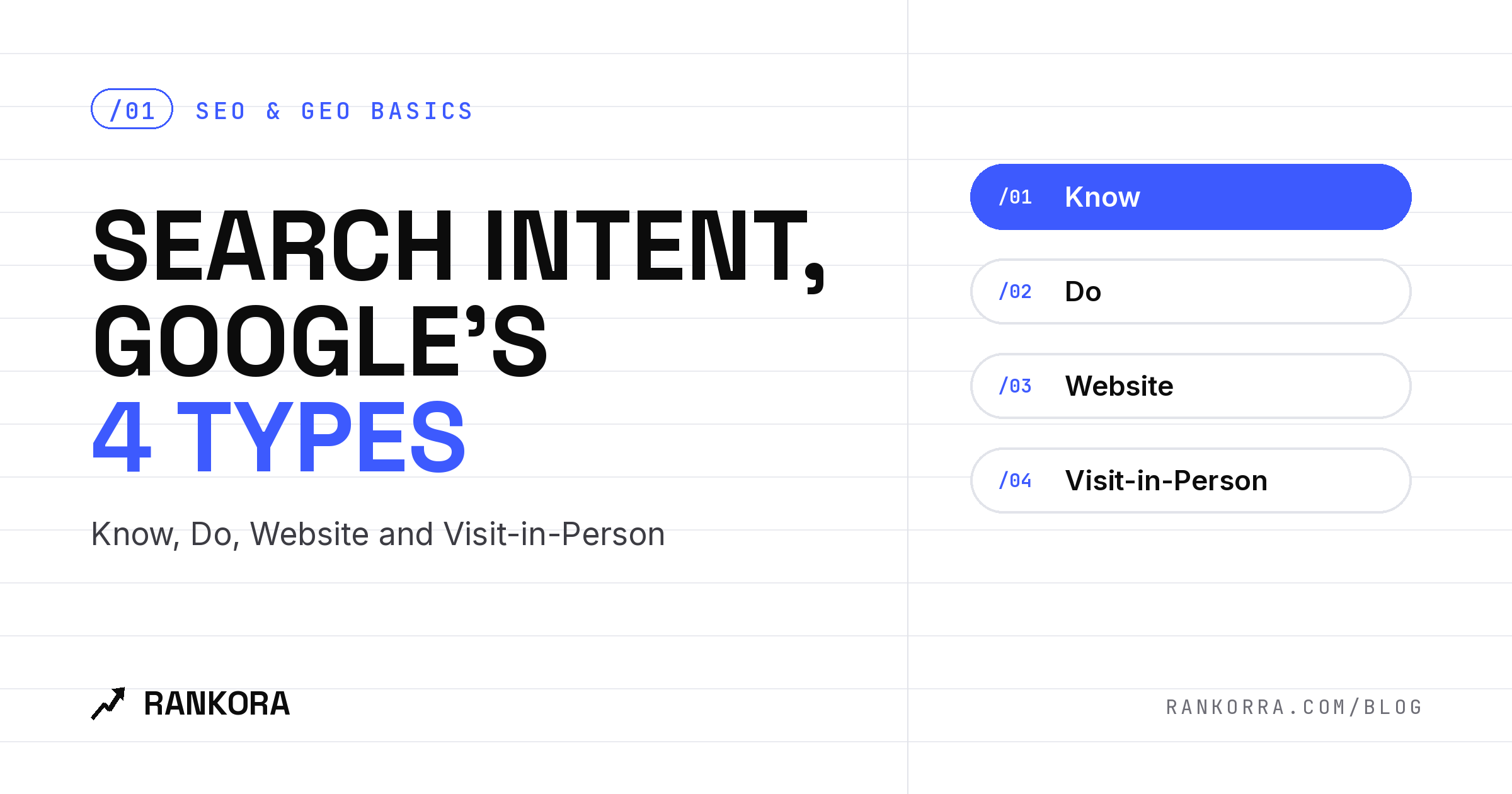
Search intent is the goal behind a query: what the person actually wants when they type it. Google's own rater guidelines sort it into four types: Know (learn something), Do (get something done), Website (reach a specific site) and Visit-in-Person (find a place nearby). Match the page you write to the type, or the best page on the topic still loses.
This isn't SEO folklore. Google's How Search Works page on ranking says that to return relevant results, Google first needs "to establish what you're looking for", which it calls "the intent behind your query." Meaning comes before relevance, quality or usability in that list.
The detailed vocabulary lives in Google's Search Quality Rater Guidelines, the manual human raters use to score results. The current edition is dated September 11, 2025, and section 12.7, "Understanding User Intent", is where the four types are defined. One caveat up front: the same document says no single rating directly moves any page up or down in Search. Raters measure whether Google's systems work. The guidelines are useful because they show what Google is trying to reward, not because a rater might visit your page.
What are the types of search intent?
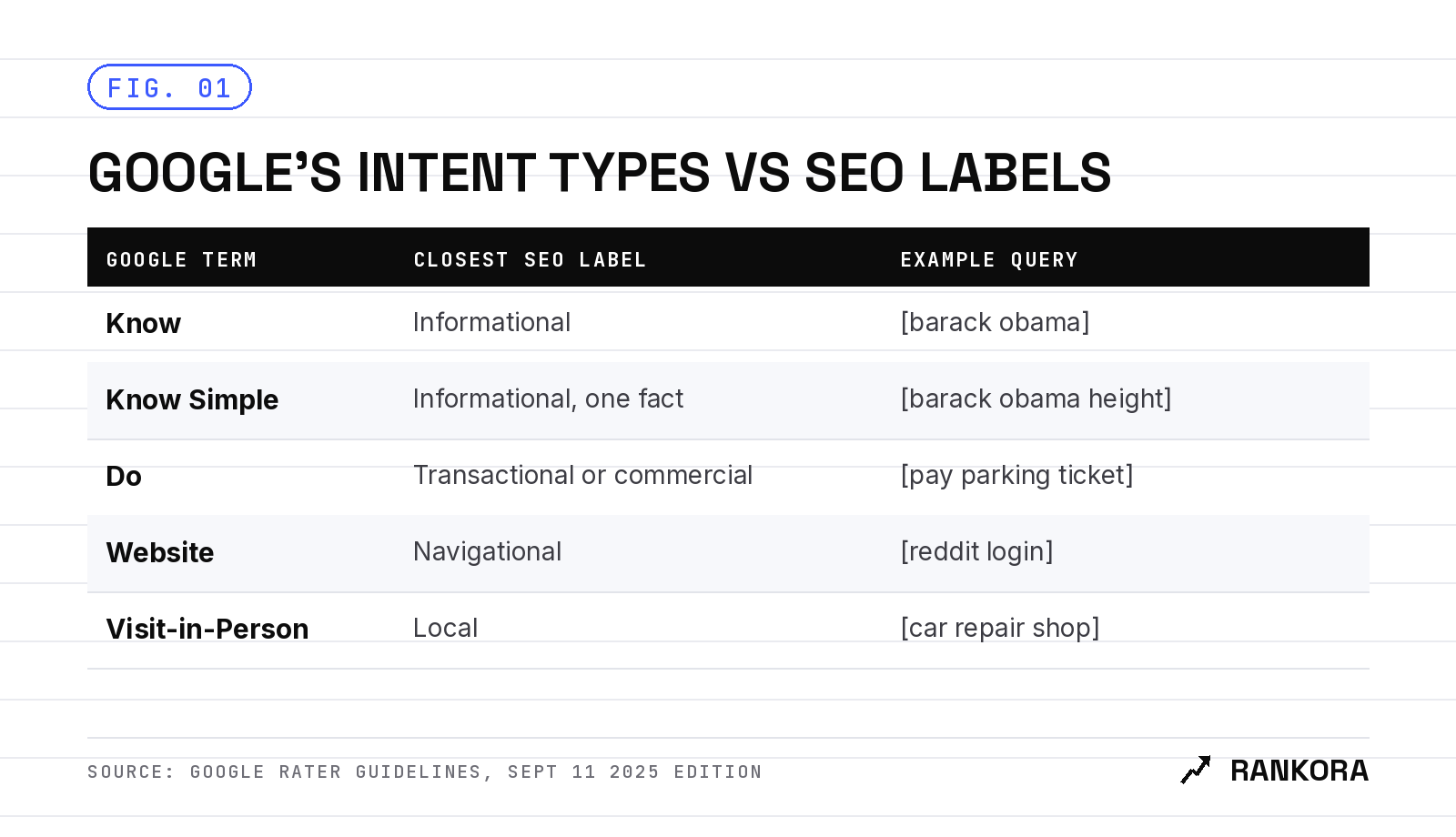
Most SEO courses teach four labels: informational, navigational, commercial and transactional. Google's rater guidelines use different names and cut the pie slightly differently. Neither set is wrong, but Google's version is the one written by the people grading the results, so it's worth knowing both.
| Google's term | What the searcher wants | Closest SEO label | Example from Google's guidelines |
|---|---|---|---|
| Know | Find information or explore a topic | Informational | [barack obama] |
| Know Simple | One correct, short answer | Informational (a single fact) | [barack obama height] |
| Do | Accomplish a goal: buy, download, watch, calculate | Transactional, sometimes commercial | [pay parking ticket] |
| Website | Reach one specific site or page | Navigational | [reddit login] |
| Visit-in-Person | Find a physical place nearby | Local | [car repair shop] |
The big difference: Google has no separate "commercial investigation" bucket. A query like "best food delivery app" sits between Know and Do, and the guidelines say plainly that the line between those two "is sometimes blurry" and that many queries don't fit neatly into one category.
Know and Know Simple: the informational queries
A Know query means the searcher wants to learn more about something. A Know Simple query is a narrower case: the answer is a fact that most people would agree on and that fits in one or two sentences or a short list. Google's example pair is [how tall is barack obama] and [barack obama height]. Same intent, one phrased as a question and one not.
The guidelines also list what is not Know Simple: broad or in-depth topics, ambiguous queries, controversial topics, questions with no single right answer, and queries where people want ideas, inspiration or personal opinions from real people. That list matters more than the definition.
Here's the practical read. If your target query is Know Simple, the answer can be shown in a small space on the results page, so a 2,000-word article gives the searcher nothing extra. If it's a broad Know query like [barack obama], different users want different things (biography, books, recent posts), and a page that covers several of those angles fits better than a one-line answer.
Do queries: when the searcher wants to act
A Do query means the person wants to accomplish something: download, buy, obtain, be entertained, or interact with a site or app. Google's examples include [pay parking ticket], [online personality test], [what is my bmi?] and [watch stranger things].
Notice [what is my bmi?]. It's phrased as a question, so an SEO tool might tag it informational. Google tags it Do, because the searcher wants to calculate a number, not read about body mass index. Question words are a hint, not proof. A calculator page beats an explainer here.
Do queries can also be open-ended. The guidelines treat [music videos] as Do even though no specific video is named, because the searcher most likely wants to watch at least one after browsing. For a commercial site, that's the "best X" and "X vs Y" territory: the reader is still choosing, but the end goal is an action.
Website queries: the navigational ones
A Website query means the user wants one specific site or page, which the guidelines call the target. Examples: [reddit login], [tiktok], [yahoo mail], [walmart.com]. Even a broken or misspelled URL counts, because the person clearly has a page in mind.
You can't win someone else's Website query, and you shouldn't try. Where this type matters is your own brand. If people search your brand name plus "login", "pricing" or "contact", those pages need to exist and be easy to find, because the searcher has already decided where they want to go.
Visit-in-Person queries: the local layer
Visit-in-Person queries look for a physical place: coffee shops, gas stations, dentists, car repair. Google's examples split cleanly. [car repair shop] and [gas stations] want nearby results. [iq test] and [how tall is mt everest] do not.
Some queries go both ways. For [walmart], one person wants the nearest store and another wants to shop online. The guidelines list [hotels], [post office] and [h&m] as other mixed cases. Google's How Search Works page uses the same idea: search "pizza" and you get nearby businesses that deliver, because the system reads local intent from a query that never says "near me". If this is your world, our guide to ranking on Google Maps covers the fixes Google itself confirms.
When one query has several meanings
Many queries carry more than one meaning, and the guidelines grade them on a scale. The dominant interpretation is what most users mean. A common interpretation is what many or some users mean. Minor interpretations are rarer, and an interpretation so unlikely that almost nobody means it is a "no chance" interpretation.
Google's examples: [apple] might mean the computer brand or the fruit. In the rater guidelines overview, [mercury] could mean the planet or the chemical element. And almost nobody searching [hot dog] in US English wants a page about an overheated pet.
Meanings also shift with time. The overview says raters should assume users want current information about a topic. For your content plan, that's a reason to re-check the results page for a keyword before every refresh, not once a year.
How to read search intent from a real SERP
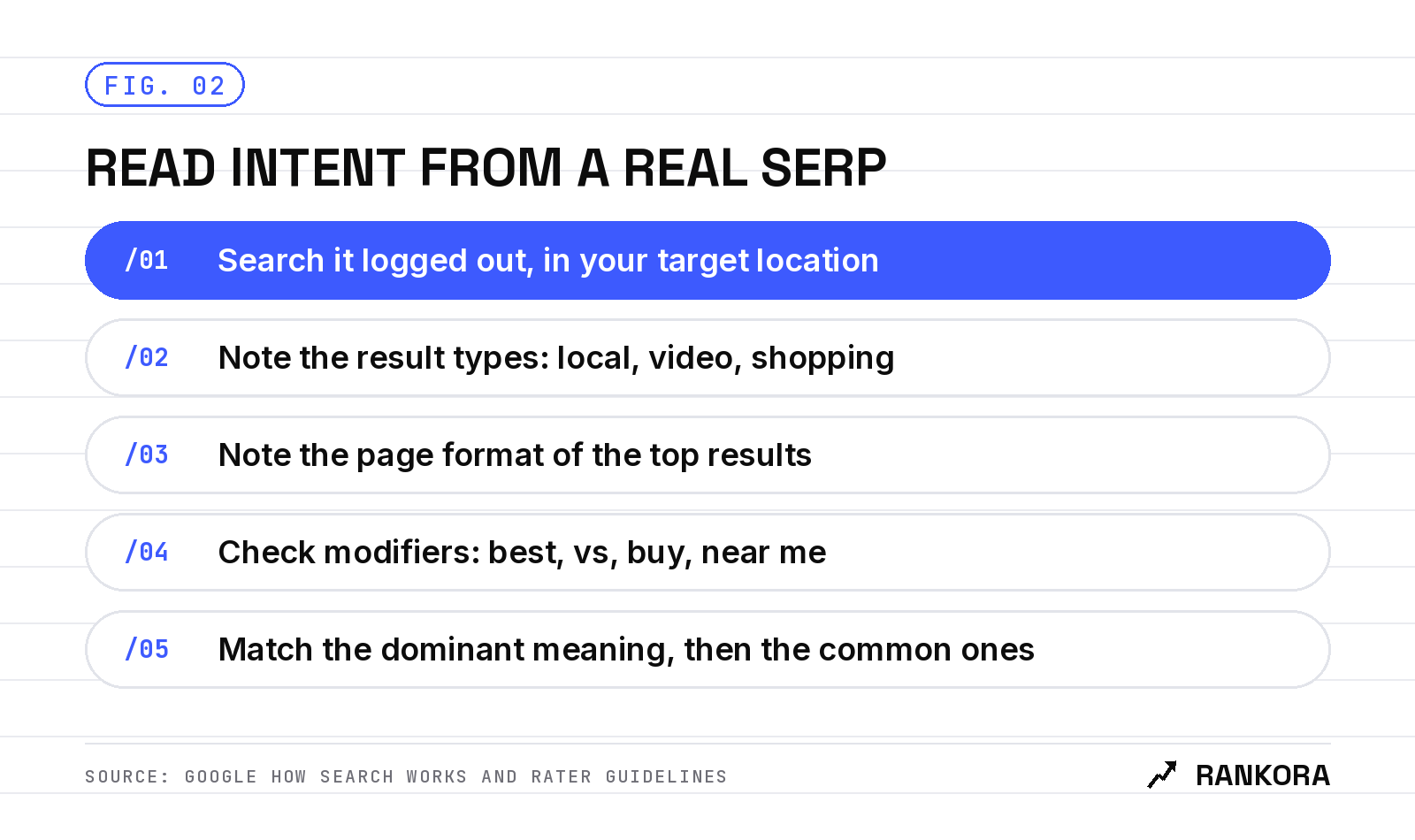
The results page is Google's current answer to "what does this query mean?" Read it before you write. Five checks cover most of it:
- Search logged out, in the market you target. Location changes results for anything with Visit-in-Person intent, so a search from Delhi tells you little about Mumbai.
- Note the result types. A map with local listings signals Visit-in-Person. Video results signal Do (watch). Google's How Search Works page gives its own example: words like "cooking" or "pictures" make recipes or images the better match.
- Note the page format of the top results. Ten listicles, ten product pages or ten tools tell you which format Google currently believes fits.
- Check the modifiers. "Best" and "vs" lean toward choosing (Do, still researching). "Buy" and "price" lean toward acting now. "Near me" is Visit-in-Person.
- Serve the dominant meaning first. Then cover the common interpretations further down the page if they fit your audience.
How search intent works in AI answers
AI answers don't remove intent. They split it into smaller pieces. Google's documentation on AI features and your website says both AI Overviews and AI Mode may use a query fan-out technique, "issuing multiple related searches across subtopics and data sources" to build a response.
So one broad question becomes several narrower ones behind the scenes, each with its own intent. A page that answers the main question and the obvious follow-ups in clearly labelled sections gives the system more passages to pick from. This is the core of GEO (generative engine optimisation), which our plain-English guide to GEO covers in full.
To see whether ChatGPT, Gemini, Claude or Perplexity actually name your brand for the questions your buyers ask, a tool like Rankora's AI visibility tracking runs those prompts and records mentions and citations.
What to do with search intent this week
Search intent is the cheapest fix in SEO because it changes what you write, not how much. Start here:
- Tag your top 20 target keywords with Google's four types. Where a page and its keyword disagree (an explainer targeting a Do query, say), you've found a rewrite.
- Look at your highest-impression, lowest-click pages in Search Console and run the five SERP checks above on their main queries. A format mismatch is the usual culprit.
- Split mixed-intent keywords. If the SERP for a term shows both local listings and guides, decide which one your page serves.
- Filter keyword lists by intent before you pick topics. Rankora's keyword research tool tags each keyword with an intent, as the screenshot below shows.
- Check page structure against the follow-up questions a fan-out would generate. The AI content optimiser is built for that on-page pass.
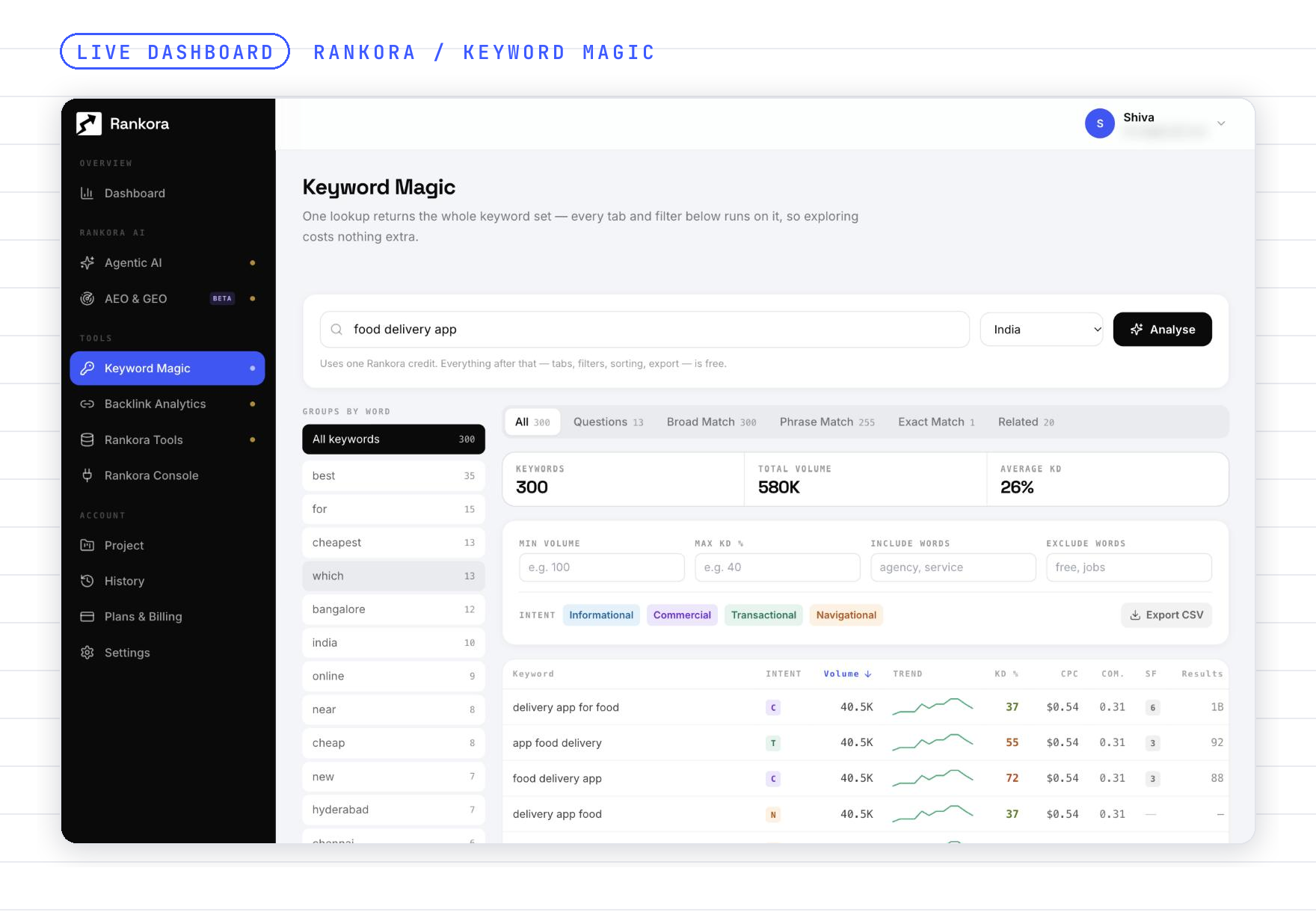
In that lookup, the seed "food delivery app" in India returned 300 keywords, with filters for informational, commercial, transactional and navigational intent. Filtering to commercial and transactional terms first is a quick way to separate "which app should I use" content from "how does food delivery work" content before either gets written.
FAQ
What is search intent in simple words?
Search intent is the reason someone types a query: what they want to happen next. They might want to learn something, do something, reach a specific website or find a place nearby. Google's rater guidelines call these Know, Do, Website and Visit-in-Person queries. A page ranks well only when it gives the searcher the type of result they came for.
What are the 4 types of search intent?
The common SEO version is informational, navigational, commercial and transactional. Google's rater guidelines use Know (including Know Simple), Do, Website and Visit-in-Person. They overlap heavily: Know matches informational, Website matches navigational, and Do covers most transactional and some commercial queries. Google's version adds an explicit local type.
Is search intent a Google ranking factor?
Google doesn't publish a factor called "search intent", but its How Search Works page says the first step in ranking is establishing the intent behind a query. Relevance and quality are judged against that intent. In practice, a page that answers the wrong intent tends not to rank for the query, however good it is.
How do I find the search intent of a keyword?
Search the keyword yourself, logged out and in your target location, and study the results page. Note the result types (local listings, videos, shopping), the format of the top pages, and modifiers like "best", "buy" or "near me". Keyword tools that tag intent speed this up across hundreds of keywords, but check the live results for the ones you plan to write.
Can one keyword have more than one search intent?
Yes. Google's guidelines give [walmart] as an example: some people want a nearby store, others the website, others news about the company. They rank meanings as dominant, common and minor. Serve the dominant meaning first, then cover common meanings where they fit your audience, and ignore meanings almost nobody has in mind.
Does search intent matter for ChatGPT and AI Overviews?
It matters more, if anything. Google says AI Overviews and AI Mode may run a query fan-out, issuing multiple related searches across subtopics to build one answer. Each of those smaller searches has its own intent. Pages that answer the main question and its natural follow-ups in clear, self-contained sections give AI systems more to draw from.
The one habit worth keeping from all of this: look at the results page before you write, every time. Google re-reads intent as meanings change, and the SERP is the only place that shows you its current reading.
Tagged